When the top of a palm tree is damaged, its trunk and root remain, yet it dies, unlike humans whose bodies dissolve after dying, standing upright and intact. They say that palm trees die standing, witnessing their own demise. The war killed many of them, yet they remained standing, alive in a sense, as a witness of the disasters that were forced not only upon themselves, their environment and the people living next to them.
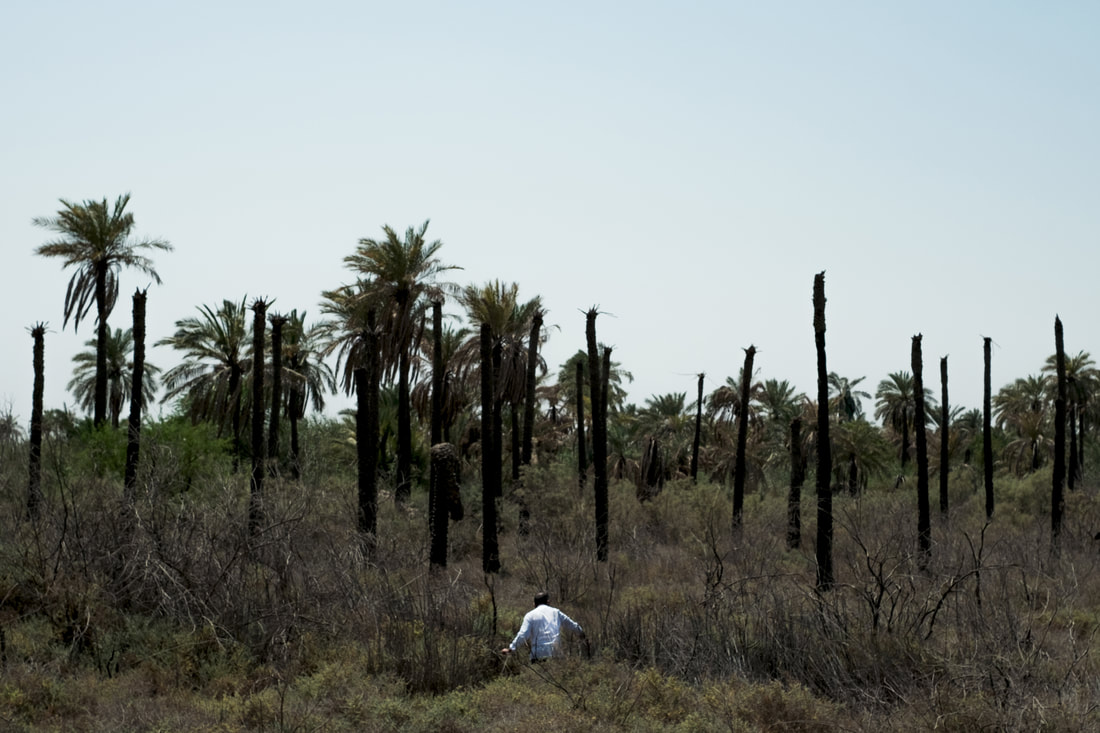
Photo by Ivo Pekec
This project is
located in the most southwestern part of Iran adjacent to the border
between the nations of Iran and Iraq. This region was highly affected by
the Iran-Iraq war (1980-1988) and still suffers from many of its
consequences, ranging from a big population decrease, migration and a
heavy environmental impact. Formerly a prosperous and affluent region,
centered around the city of Abadan, known for its oil refineries, it
lost its prominence.
The design for the border landmark bases its concept on the characteristic date palm trees of the Khusezstan Province of Iran, once densely populated by them. Today these palm trees are a scarce appearance as mostly their destroyed remains from the war are left behind.
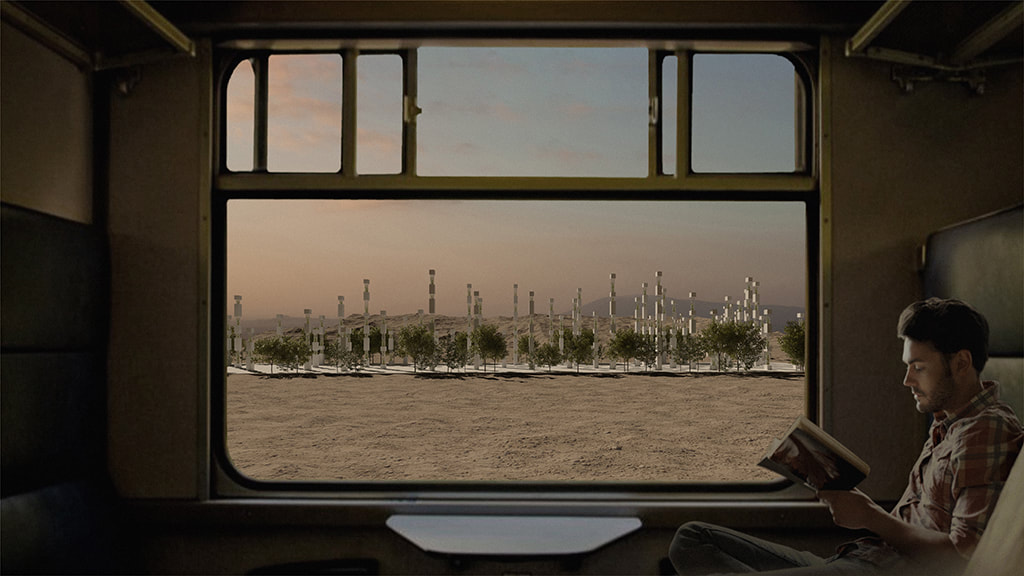
The project interprets the dead trunks of these palm trees as the incubator of the memory of the events that took place in this region, beyond the war that decapitated them, using them as a formal inspiration for the design and as the essence of its symbolic meaning. The design consists of modular columns, intermixing solid and living elements, creating a complex fabric with a simple stacking of three basic combinations. Intended originally by the client as a gate for the border region, it dissolves the notion of border from a solid line into a fragmented and dissolved atmospheric space, implying a change in territory.
The mixture of solid and green elements infuses the sorrowful memories of war that the palm trees carry with a hopeful sense for change in the near future. Given the serious climate changes that this region is facing today, this project, beyond its symbolic implications, creates a micro-climate suitable for human presence. This micro-climate is achieved with the implementation of a passive air regulating system as part of the same columns.
The design for the border landmark bases its concept on the characteristic date palm trees of the Khusezstan Province of Iran, once densely populated by them. Today these palm trees are a scarce appearance as mostly their destroyed remains from the war are left behind.
The project interprets the dead trunks of these palm trees as the incubator of the memory of the events that took place in this region, beyond the war that decapitated them, using them as a formal inspiration for the design and as the essence of its symbolic meaning. The design consists of modular columns, intermixing solid and living elements, creating a complex fabric with a simple stacking of three basic combinations. Intended originally by the client as a gate for the border region, it dissolves the notion of border from a solid line into a fragmented and dissolved atmospheric space, implying a change in territory.
The mixture of solid and green elements infuses the sorrowful memories of war that the palm trees carry with a hopeful sense for change in the near future. Given the serious climate changes that this region is facing today, this project, beyond its symbolic implications, creates a micro-climate suitable for human presence. This micro-climate is achieved with the implementation of a passive air regulating system as part of the same columns.


This project was done in
collaboration with Ivo Pekec, Nazanin Zakeri and Aida Golnari. It won
the first prize in the design competition for a border landmark and was
commissioned to the winner architects by the Arvand Free Zone.